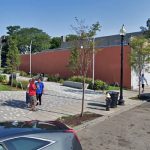

 Director of Construction, Gerry Patton, on the Balina Place build site featuring a group of volunteers in the background, finishing up the interior details on the locations first home | Photo by Danielle Buote
By Danielle Buote
Habitat for Humanity (HFH) is a nonprofit organization dedicated to providing decent and affordable housing for people in the United States and approximately 70 other countries. Habitat works with individuals as well as school, religious, and corporate volunteer groups to build homes for families in all kinds of communities, even here in Dorchester.
Habitat for Humanity Greater Boston, which oversees the district including Dorchester, partners with families that demonstrate a need for safe, decent, affordable housing, a willingness to team up with Habitat, and the ability to pay a low-cost mortgage. For example, a family of four applying for a Greater Boston home would need to have an income falling between $53,900 and $81,100. While at first glance this may seem like a rather high income, these numbers represent just 50% to 80% of the Area Median Income in the Boston area, as determined by the Department of Housing and Urban Development.
Living in or around Boston is expensive and the prices are only getting higher. Displacement is a devastating problem in these communities, especially in Dorchester. Due to the rising cost of rent and unlivable wages, these families are unable to save for a down payment on a home and are left with few options, often being forced to relocate away from their jobs, relatives, children’s schools, public transportation, and the city in which they built their life. If lucky, some families may be able to pack into a tinier apartment or move in with other family members. But for many others, shelters and the streets are the only place left.
HFH Greater Boston offers families an opportunity to obtain stability before there is nowhere left to turn. Volunteers and dedicated employees work to create a foundation for families who, in spite of their decent income, can not afford a traditional mortgage and often are already living in “overcrowded, too expensive, or unsafe” places.
A different kind of down payment
 With the exterior of the first Balina Place home complete, Habitat is now finishing up interior work such as painting and floor work | Photo by Danielle Buote
At Habitat for Humanity, it’s not just about a new home, it’s about an opportunity for a better life. Habitat provides families with security as homeowners capable of building equity and community for a promising future.
Mortgages for Habitat homes have 0% interest and instead of a traditional down payment, families are required to attend homeownership classes and complete 300 “sweat equity hours” by working on Habitat homes, at the ReStore, or in the office. These experiences not only ensure that the family is invested in the process, but also teaches them skills in financial stability, leadership, and home repair. Homes are also built to LEED standards, meaning that the houses are both environmentally friendly and conducive to cost-effective energy bills.
HFH Greater Boston’s current project is located at Dorchester’s Balina Place where construction is just about complete on the first structure which will house two Habitat families moving in this summer. Construction on the project’s second structure, which will house three more families, began in June and is expected to be completed next summer.
Gerry Patton, Director of Construction at HFH Greater Boston and on site supervisor at Balina Place, has been working with volunteers for fifteen years. “Everyone is here because they want to be here” Patton says. “While watching families move in is the best part, working with volunteers has been equally rewarding. They help make this program possible.”
Patton tells a story of when a corporate group came to volunteer at a HFH Greater Boston project and one of the volunteers was put in charge of the group, causing her to actually be in charge of her boss. Patton says that her supervisor “saw her in a whole new light, that she was capable of being in charge and leading people” and as a result, the woman was reviewed for a promotion at her job.
Habitat allows not only volunteers to be seen in this “whole new light”, but also Habitat homeowners.
The Cressy family, pictured below, moved into the first Balina Place unit in early July. Ben and Liz met 9 years ago while working in community development in Dorchester. They married, started a family, and promptly found themselves priced out of a suitable home for their growing family. When a friend tipped them off that Habitat was building homes in their old neighborhood, they immediately applied. “Being able to move back to the neighborhood where we spent years growing roots and building a strong community, and especially to be able to move back as homeowners, was a dream come true” the Cressys say.
 Cressy family in front of their new home on Balina Place | Photo by Habitat for Humanity Greater Boston
Reflecting on their journey as the 60th partner family to move into a Habitat home in Dorchester, the Cressys say, “It’s great to be back and part of something really positive happening in this community.”